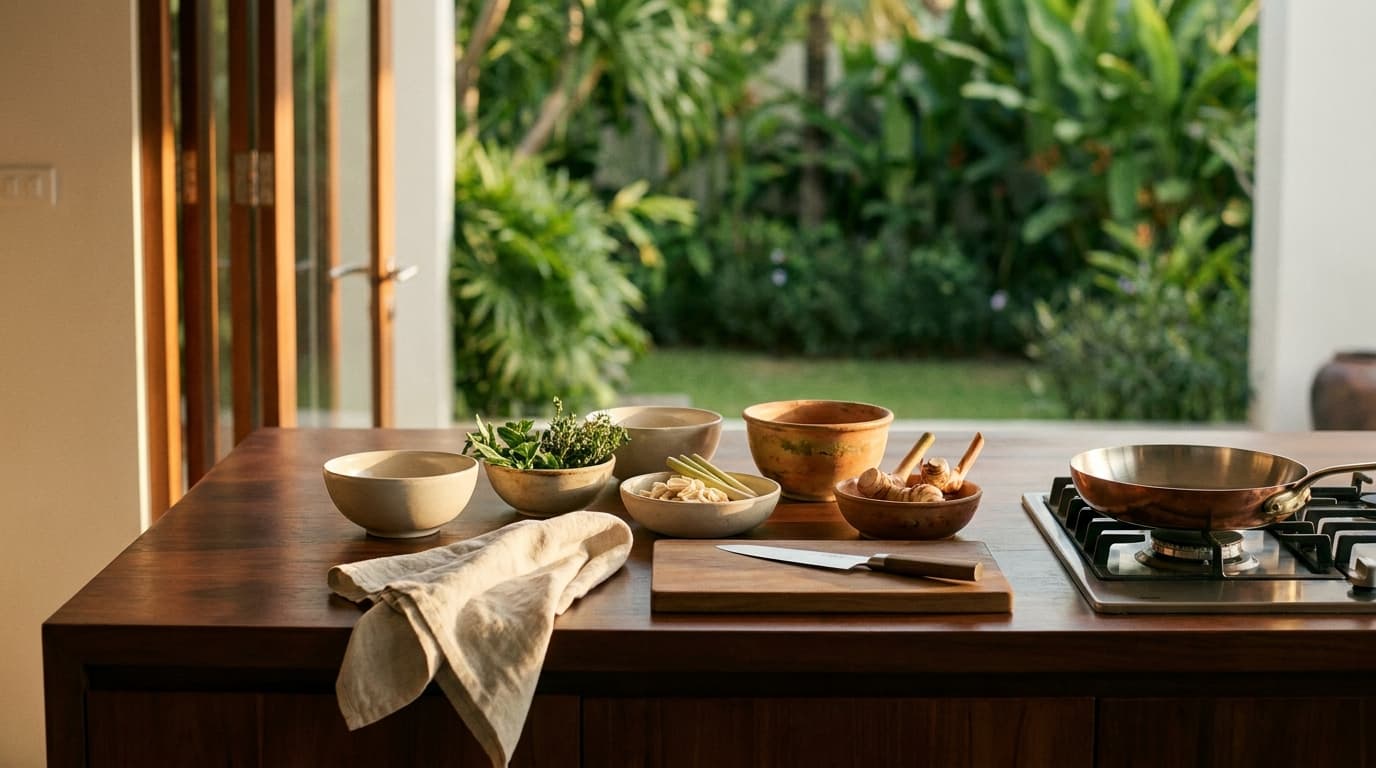
A private chef arrangement for an executive retreat in Thailand means a dedicated cook prepares breakfast, lunch, dinner, and often workshop breaks for your group at a villa or private venue, working outside the hotel restaurant structure. You hire the chef directly (or through your DMC), they bring ingredients to the property, and they use the villa kitchen or an on-site prep space. This setup works when you want full menu control, accommodate complex dietary requirements, or run a retreat at a non-hotel property that lacks kitchen staff.
The choice between a private chef and the hotel's culinary team comes down to venue type, group size, and how much menu flexibility you need. If you book a standalone villa with 8-15 participants, you will need a private chef. If you take over a wing of a resort with 40 participants, the hotel's catering team often delivers better economies of scale. The middle ground (15-25 participants at a boutique property) is where the decision gets tactical.
When a private chef makes sense
You book a private chef when the venue does not have adequate kitchen staff, when dietary restrictions span more than two or three profiles, or when the retreat schedule requires non-standard meal timing. A villa estate rarely includes a full-time cook. The property manager can arrange a freelance chef, but quality varies widely, and you inherit the vetting risk. We maintain a shortlist of nine chefs on Samui and four in Phuket who have cooked for corporate groups before, speak English fluently, and understand allergen cross-contamination protocols.
Private chefs also make sense when the retreat includes cooking workshops, farm-to-table sourcing narratives, or specific regional cuisine requirements. If the agenda calls for a northern Thai menu one night and southern seafood the next, a freelance chef with that range is easier to brief than a hotel kitchen constrained by its standard repertoire. The same applies to plant-based or kosher menus; hotel kitchens can accommodate these but often subcontract to a specialist anyway.
The trade-off is operational overhead. You own the procurement risk, the schedule coordination, and the kitchen access logistics. If a participant has an allergic reaction to undeclared peanut oil, the liability sits with you, not with a hotel F&B director.
Day rates and what drives them
Freelance chefs on Koh Samui charge between USD 200 and USD 600 per day, depending on training background, language capability, and group size. A Samui-based cook with hotel kitchen experience and conversational English typically quotes USD 200-300/day for groups under 12. A Bangkok-trained chef who has worked at Gaggan, Nahm, or one of the Mandarin Oriental properties will quote USD 400-600/day and expects you to cover transport and accommodation if the retreat runs multiple days.
The rate covers the chef's time, menu planning, and on-site cooking. It does not cover ingredients, which you budget separately at around USD 35-60 per person per day for three meals, depending on protein choices and import requirements. A group of 10 over three days would run approximately USD 1,800 in chef fees (USD 300/day × 6 days for prep and cook) plus USD 1,500-2,000 in ingredients and incidentals.
Thai chefs expect payment in baht, in cash, at the end of each day or at the retreat's conclusion. A few accept bank transfer, but this is not standard. Plan for a 10% tip if the service exceeds expectations; this goes directly to the chef, not to any sous-chefs or kitchen assistants they bring.
Chefs who quote below USD 180/day for groups over eight are usually home cooks without commercial kitchen background. This tier can work for low-stakes internal offsites but introduces food safety risk and lacks the flexibility to adapt menus on the fly when a participant's dietary requirement was miscommunicated.
Dietary requirements and allergen protocols
The brief should list every participant's dietary restriction, religious requirement, and known allergen at least 10 days before arrival. The format that works best is a spreadsheet: name, restriction type (vegetarian / vegan / gluten-free / lactose intolerant / etc.), severity (preference vs. medical), and any specific ingredients to avoid. A notation like "shellfish – anaphylaxis" is clearer than "seafood allergy," which some chefs interpret as excluding only finfish.
Thai chefs trained in hotel kitchens understand cross-contamination and will use separate cutting boards, utensils, and cookware for allergen-free prep. Chefs without formal training often do not, and will reuse a wok between dishes or assume rinsing is sufficient. This gap is why we require a phone conversation between the planner and the chef before contract signature, where the chef repeats back the allergen list and describes their prep workflow.
Ingredient labels in Thailand do not always disclose shared production lines. Imported packaged goods are safer for severe allergies, but they cost more and require advance ordering. Samui's supply chain tightens in low season (May-October), when fewer cargo ships dock and supermarkets stock less inventory. A celiac participant requires certified gluten-free tamari, rice noodles from a dedicated facility, and separate fryer oil; securing these items in September takes 5-7 days and may require a Bangkok shipment.

Menu pre-tasting and why it matters
A pre-tasting is a small test meal the chef prepares 1-3 days before the retreat starts, either at their home kitchen or at the venue if setup allows. You or your local liaison tastes three dishes that represent the planned menu's range: a protein, a vegetable dish, and a carbohydrate. This step costs an additional half-day rate (USD 100-250) but catches seasoning mismatches, portion misjudgments, and whether the chef interprets "mild spice" the way your group will.
We require a pre-tasting for any retreat over USD 30K in total budget, any group with more than two dietary profiles, or any first-time chef engagement. Planners sometimes skip this to save cost, then discover on Day 1 that the chef's "Western-style breakfast" means instant coffee and white bread, or that portion sizes assume Thai appetites (which are smaller than North American or European norms).
The pre-tasting also confirms kitchen access and equipment. If the villa's stove has only two working burners, or the refrigerator cannot hold three days of ingredients, you find out before the group arrives. Chefs will flag these constraints, but only if they cook on-site beforehand. A walk-through without cooking misses the operational friction.
Kitchen access and ingredient sourcing pitfalls
Most Samui villas have a residential kitchen: a four-burner gas stove, a single oven, a 400-liter refrigerator, and counter space for two people. A chef cooking for 12 can manage this if the menu is sequential (prep one course while the previous course is plating). A chef cooking for 20 cannot, unless the villa has a separate prep kitchen or outdoor cooking pavilion. Ask the property manager for the kitchen's equipment manifest and photos before you confirm the chef.
Villas without staff quarters expect the chef to arrive each morning and leave after dinner service. This adds 1-2 hours of daily travel if the chef lives on the opposite side of the island. Some chefs will not take bookings on the far east coast (Lamai to Hua Thanon) because the commute is too long. Others will, but increase their rate by USD 50/day to cover fuel and time.
Ingredient sourcing depends on the season and the menu's specificity. Makro (a cash-and-carry chain) and Tesco Lotus stock most staples year-round. Fresh seafood comes from the morning markets in Bophut, Maenam, or Lamai; availability is good from November to March, spottier from April to October. Imported cheeses, charcuterie, and specialty produce (radicchio, fennel, heirloom tomatoes) require orders from Bangkok suppliers, which add 5-10 days of lead time and 15-20% markup over Bangkok retail.
Chefs source ingredients themselves and pass the cost to you with receipts. Some add a 10% procurement fee; this should be disclosed in the contract. If the retreat includes alcohol, the chef does not procure it; Thailand's licensing rules mean wine and spirits come through a separate vendor or the planner buys them directly.
Low season (May-October) creates two sourcing problems. First, import volumes drop, so specialty items may be unavailable. Second, many small vendors close for weeks at a time, narrowing your options. A retreat in July requiring organic vegetables and grass-fed beef needs a longer sourcing window than the same retreat in January.
Private chef versus hotel catering: a comparison
| Factor | Private Chef | Hotel Catering |
|---|---|---|
| Cost (per person/day) | USD 55-90 all-in | USD 70-140 depending on property tier |
| Menu flexibility | High; chef adapts daily | Moderate; constrained by hotel's ingredient inventory |
| Dietary customization | High if briefed correctly | High at top-tier properties, inconsistent elsewhere |
| Kitchen equipment risk | You inherit it | Hotel owns it |
| Lead time | 7-10 days minimum | 14-21 days for group menus |
| Liability | Planner or DMC | Hotel assumes food safety liability |
| Alcohol service | Separate arrangement required | Included in F&B package, licensed |
| Ideal group size | 6-20 participants | 20+ participants |
How we vet chefs for retreat clients
Halia maintains a shortlist of chefs who have cooked for at least three multi-day corporate groups in the past 18 months. Each chef on the list has provided references, demonstrated allergen handling protocols, and completed a test meal at one of our preferred villa properties. We do not vet hotel catering teams; the properties we work with (Conrad Koh Samui, Six Senses Samui, Four Seasons Koh Samui, Anantara Bophut) already have internal quality controls.
When a retreat brief includes complex dietary requirements or a request for a specific regional cuisine, we propose two chefs with relevant background and arrange intro calls. The planner chooses based on communication style and menu approach. We do not mark up the chef's rate; the client pays the chef directly or we include it as a line item in the retreat invoice at cost.
The shortlist updates quarterly. Chefs rotate off if they miss deadlines, deliver inconsistent quality, or stop taking corporate bookings. New chefs are added when referred by a property manager we trust or after a successful trial engagement on a lower-stakes project.
If your retreat brief requires a private chef arrangement, send us the participant count, dietary requirements, and venue details. We typically respond with chef options and a preliminary cost breakdown inside 48 hours. Contact us here to start that conversation.