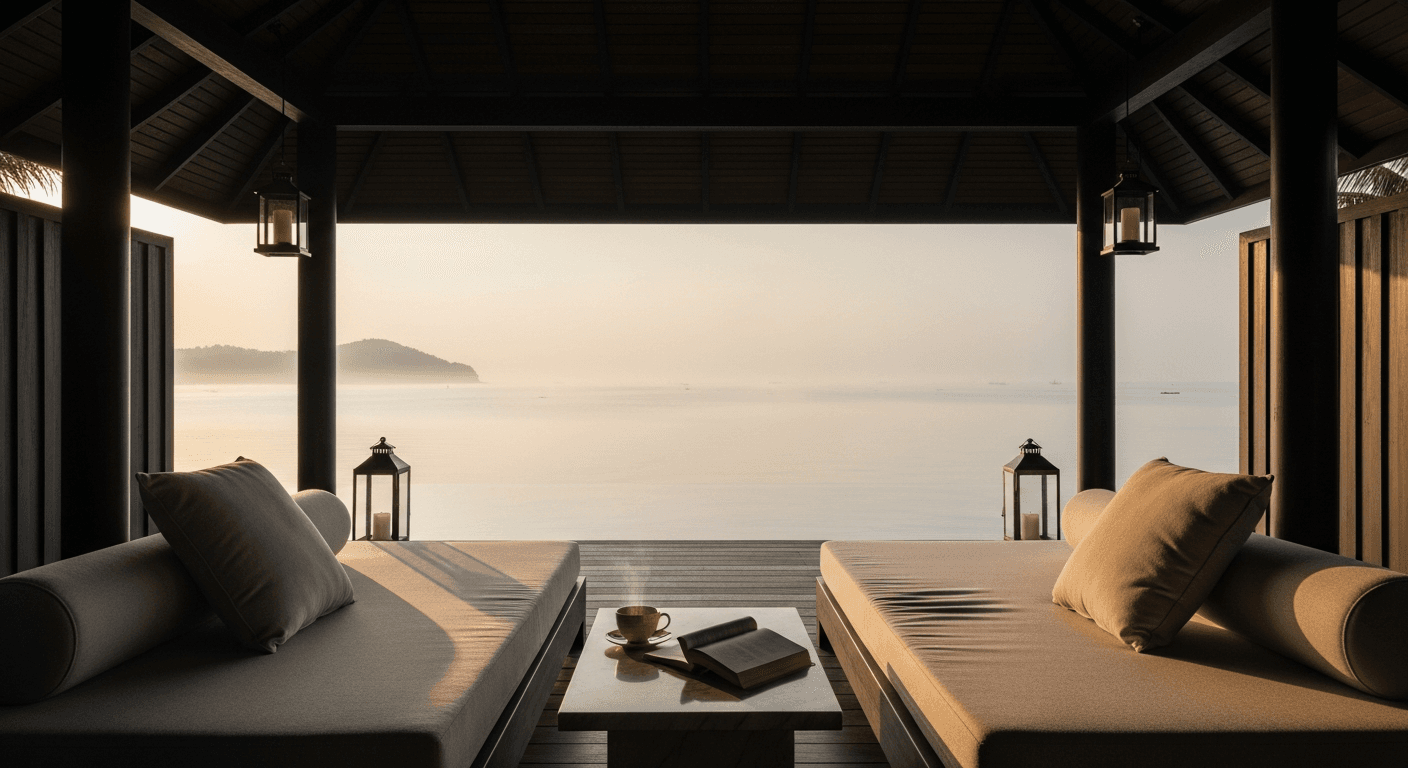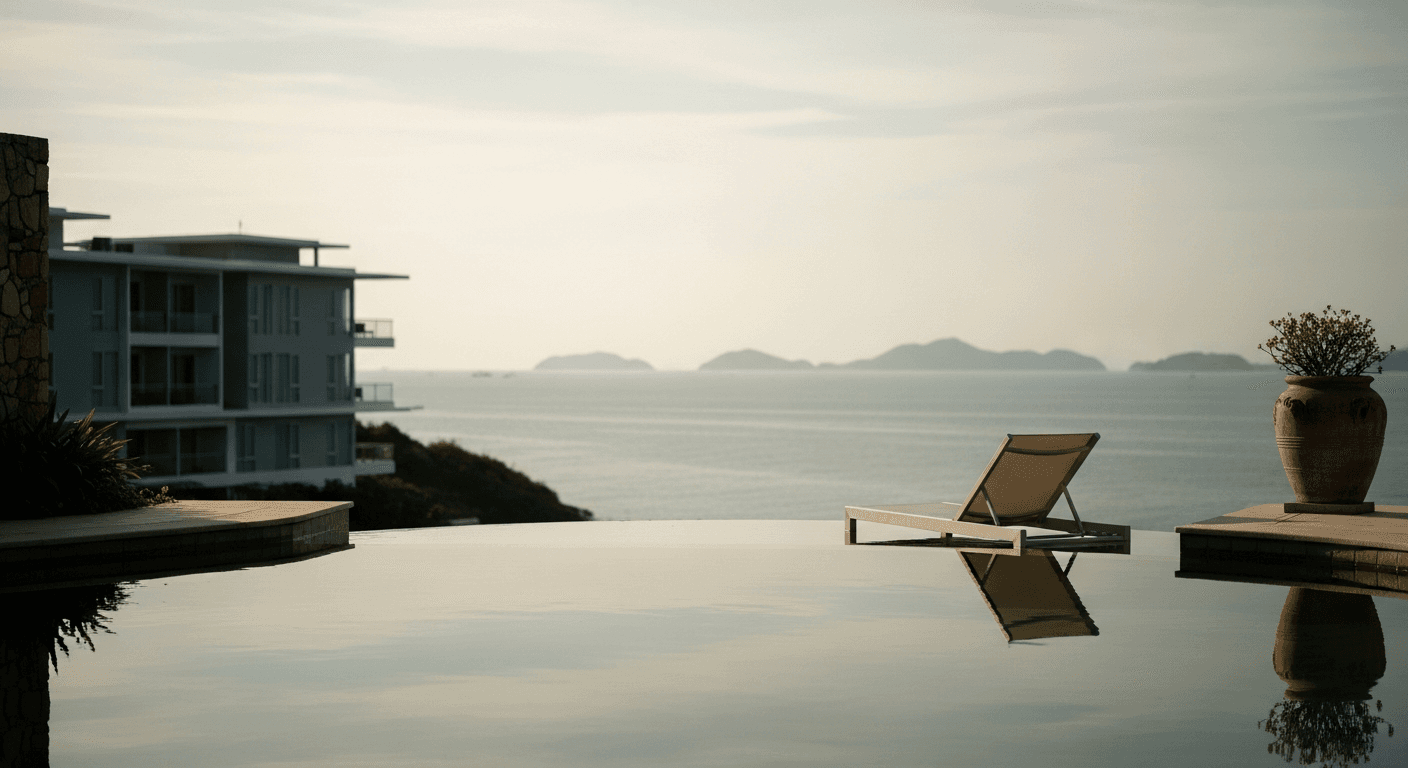
A private villa on Koh Samui is a standalone residential property, typically 5-12 bedrooms, with full-time staff including a chef, daily housekeeping, and a dedicated estate manager. Groups rent the entire property for the duration of the retreat, gaining exclusive use of all common areas, pools, kitchens, and grounds. Most villas include all meals prepared to specification, beverages, and daily service in the rate.
Hotels allocate a block of individual rooms within a larger property. Common areas remain shared with other guests, and meals are served in hotel restaurants on menus designed for a general audience. Service runs on fixed schedules rather than adapting to the group's rhythm.
The choice depends less on budget—competitive villas and hotel blocks often converge in total cost per person—and more on group size, privacy requirements, and how much control the program needs over environment and schedule.
When villas make operational sense
Villas outperform hotels for groups of 8-18 participants who need uninterrupted focus. The property becomes an isolated environment. No public areas to navigate, no check-in queues, no unrelated guests in the pool at 6 a.m. Sessions can run in indoor or outdoor spaces without booking conference rooms or coordinating with hotel operations.
The chef model changes how food functions in the program. You set menus a week before arrival based on dietary restrictions and preferences you already know. Breakfast runs as long as the group needs it. Lunch timing adjusts if a morning session runs over. The kitchen accommodates requests without service charges. For leadership groups with specific nutritional protocols or teams with complex dietary matrices (vegan, halal, allergies), villa kitchens adapt faster than hotel banquet operations.
Staff-to-guest ratios in shortlisted villas run 1:2 to 1:3, compared to 1:8 or worse in four-star hotels. The estate manager serves as a single point of contact for all requests. Issues get resolved in minutes, not routed through front desk protocols.
Privacy carries weight for groups conducting sensitive strategy work or boards in succession planning phases. Villas eliminate the risk of hallway encounters with industry peers staying at the same hotel. No conference room walls shared with other bookings. The property perimeter is defined and controlled.
When hotels deliver better infrastructure
Hotels become the stronger option once group size crosses 20 participants. Villas that sleep more than 18 are rare on Samui, and the few large estates (14+ bedrooms) often sacrifice the intimate layout that makes villas effective in the first place. Hotels scale room inventory without forcing the group into dormitory-style bedroom arrangements.
Brand properties offer predictability that reduces pre-arrival anxiety for risk-averse stakeholders. Marriott, Hyatt, and InterContinental standards are known quantities. Site inspection photos of a villa, no matter how detailed, cannot replicate the psychological reassurance of a recognized flag. For companies with travel policies that specify chain hotels, villas may not clear procurement review even if they deliver better program outcomes.
Gym and spa access matters for participants who maintain strict fitness routines or who use spa treatments as retreat downtime. Villa gyms are minimal—typically cardio equipment and free weights in a repurposed room. Hotel wellness centers run full class schedules, trainer access, treatment menus, and hours that extend beyond villa staff shifts. If half the group expects a 90-minute Thai massage on property, hotels integrate that seamlessly.
Liability perception favors hotels in some corporate structures. Hotels carry comprehensive insurance, visible safety protocols, and documented emergency procedures. Villas operate under Thai residential regulations with more variation in how safety infrastructure is implemented. For groups from heavily regulated industries or with stringent duty-of-care frameworks, hotel legal footing is cleaner.
Cost structure comparison
| Factor | Private Villa | Hotel Block |
|---|---|---|
| Pricing model | Whole-property rate per night (typically $3,000-$12,000) | Per-room rate × number of rooms |
| Meals included | All meals, beverages, snacks included in base rate | Meals billed separately, typically $80-$150 per person per day |
| Service charges | Built into rate or minimal (5-10%) | 10% service + 7% VAT on all F&B and meeting space |
| Meeting space | Included (living areas, terraces, sala pavilions) | Charged separately if formal setup required ($500-$2,000/day) |
| Minimum night stay | 3-5 nights typical | 2 nights typical, more flexible |
| Breakage/damages | Deposit required ($2,000-$5,000) | Charged to master account as incurred |
| Cancellation terms | 60-90 days, often stricter | 30-60 days, more standardized |
Total cost per person often falls within 15% of each other when fully loaded, assuming a 4-night retreat for 14 participants. Villas front-load costs but eliminate incremental charges. Hotels appear cheaper on the room rate but F&B and meeting space add 40-60% to the initial quote.
Operational constraints planners underestimate
Villas require detailed advance communication. Menus, dietary restrictions, arrival/departure times, preferred breakfast schedule, alcohol preferences, special equipment needs—all of this must be locked two weeks before check-in. Villa kitchens order provisions from wholesale suppliers on fixed schedules. Late changes mean limited ingredients or higher costs for rush sourcing. Hotels operate from standing inventory and adjust more fluidly, though with less customization.
Transportation logistics differ. Villas sit in residential hillside areas, often 15-25 minutes from venues suitable for off-site sessions or team activities. Hotels cluster in beach zones with denser service infrastructure. If the program includes daily off-property sessions, hotel positioning may reduce transfer time by 30-40 minutes daily.
Villas assume the group occupies all bedrooms. Booking a 10-bedroom villa for 8 people is standard—you rent the property, not the beds. Hotels bill by occupied rooms, so a group of 12 in a 15-room block pays for 12. Villas penalize small groups unless sized precisely.
Weather contingency is simpler in hotels. If a tropical downpour cancels outdoor sessions, hotels offer multiple indoor alternatives. Villas adapt using existing indoor spaces, which may not have proper AV setup or seating for full-group formats. May-October (monsoon transition) programs should factor weather backup into the villa vs. hotel calculus.
What Halia's villa shortlist addresses
Halia maintains relationships with 5-7 villa properties that clear the operational threshold for leadership groups: professional estate management, experienced retreat chefs, layout that supports both group sessions and private decompression, and responsive ownership. These properties handle 80% of villa-suitable briefs without requoting surprises or service gaps.
The shortlist excludes ultra-luxury estates designed for leisure family stays (12+ bedrooms, theme-park amenities, leisure-focused staff) and bare-bones vacation rentals marketed as villas but lacking retreat infrastructure. Each property has hosted multiple corporate groups, knows how to accommodate session schedules, and maintains vendor relationships for AV, wellness, or transport add-ons.
Villas get matched to program profile—groups prioritizing wellness receive properties with yoga salas and in-villa therapists on call; strategy-intensive programs get villas with large indoor working spaces and strong Wi-Fi backbone; teams building culture receive properties optimized for communal dining and social areas.
How to make the call
Start with group size. Under 16 participants, evaluate villas first. Over 22, default to hotels unless privacy justifies splitting into two villas. Between 16-22, other factors dominate.
Map the program's session structure. If 60%+ of program time happens on property in discussion or workshop formats, villas provide better environments. If the retreat uses the accommodation primarily as a sleep base between off-site activities, hotels add unnecessary cost.
Test stakeholder comfort with non-branded properties. If your CEO or procurement lead needs logo recognition, resolve that political reality before investing time in villa specs.
Consider whether your participants value communal living. Some leadership teams bond faster in shared villa spaces. Others prefer the boundary that separate hotel rooms provide. Neither is wrong, but mismatches generate friction.
Halia runs this decision framework with you during the brief response phase and provides shortlist options in both categories where group parameters allow. Briefs submitted through the contact form receive property recommendations and ballpark costing inside 48 hours. If the match isn't obvious from the brief alone, we ask four clarifying questions before proposing options. Visit the contact page to start the conversation.