Wellness programming for incentive groups in Thailand splits into two tiers: hotel-managed spa circuits at properties like Six Senses or Amanpuri, and independently layered programming at mid-tier properties where the in-house spa cannot scale or specialize for 20–60 participants arriving on the same day.
Most hotels on Koh Samui maintain 4–8 treatment rooms. Booking 30 participants into 90-minute massage slots takes two full days if you run sequential scheduling. The spa becomes a bottleneck, not an amenity. Group coordinators often default to optional spa vouchers, which fragment the schedule and leave 40 percent of participants sitting by the pool waiting for their slot. That works for leisure groups. It fails for incentive cohorts where shared rhythm matters and the program is designed to build collective momentum.
The solution is programming that sits outside the spa menu: outdoor sessions, group formats, and practitioners who operate at scale without requiring treatment rooms.
Independent practitioners vs. hotel spa operations
Hotel spas handle individual treatments well. They struggle with simultaneous group experiences. A sound healing session for 25 participants requires one facilitator, one large indoor or outdoor space, and 90 minutes. A breathwork circle needs similar logistics. A Muay Thai conditioning session needs a trainer, gloves, pads, and a flat surface. None of these require treatment rooms or interfere with the spa's standing guest bookings.
Independent practitioners bring specialization the hotel cannot staff full-time. Hotels employ massage therapists and occasionally a yoga instructor. They do not keep sound healers, ice bath facilitators, or former stadium fighters on payroll. Bringing in external talent lets you design sessions that differentiate the program beyond what the hotel's wellness menu offers every other week.
The coordination trade-off: independent practitioners require advance booking, site visit confirmations, and equipment logistics. A hotel spa books through a single point of contact. An independent layer means managing 3–5 vendor relationships for a four-day program. That overhead makes sense when the group size exceeds the spa's treatment capacity or when the brief calls for programming the hotel cannot deliver in-house.
Morning vs. afternoon scheduling
Morning sessions between 7:00 and 9:30 work for high-output disciplines: HIIT-style Muay Thai, beach runs, sunrise yoga, cold exposure. Participants arrive with baseline cortisol still elevated. Energy is available. The sessions function as an activation layer before the day's business programming or free time.
Afternoon slots after 15:00 suit recovery formats: yin yoga, guided meditation, sound baths, Thai massage workshops. The group has spent mental budget on meetings, site tours, or water sports. The session design should downregulate, not demand output.
Scheduling wellness before dinner creates a buffer that prevents the session from feeling like an obligation inserted into free time. A 16:00 breathwork circle ends at 17:30. Participants shower and meet for drinks at 19:00. The session sits inside the day's structure rather than appended to it.
Avoid midday slots between 11:00 and 14:00 unless the format is low-intensity and the space is climate-controlled. Outdoor yoga at 12:30 in April is a heat management problem, not a wellness experience.
Optional programming vs. anchor experiences
Optional wellness programming—spa vouchers, self-booked massage slots, morning yoga with sign-up sheets—sees 30 to 50 percent participation. It works when wellness is a secondary amenity and the brief prioritizes free time. It fails when the goal is to create a shared experience that reinforces group cohesion.
Anchor experiences are scheduled for the full group with opt-out available for medical or personal reasons. A 60-minute sound healing session on Day 2 at 16:30. A Muay Thai basics workshop on Day 3 at 8:00. These become tent-pole moments in the itinerary that participants reference later. Opt-out rates for well-designed anchor sessions run below 10 percent if the session is positioned as part of the program rather than an added obligation.
The middle approach: anchor one or two signature wellness experiences and leave additional sessions optional. A four-day program might include a required sunrise yoga session on Day 2 and an optional Thai massage workshop on Day 3. The anchor builds collective rhythm. The optional programming absorbs individual preference without fragmenting the schedule.
Demographic and cohort considerations
High-performer sales incentive groups skew younger and expect intensity. These cohorts respond to challenge-based formats: Muay Thai pad work, HIIT circuits, open-water swimming clinics. Recovery programming like sound baths or meditation can feel mismatched unless framed as performance optimization rather than relaxation. Positioning matters. A breathwork session marketed as a stress-reduction exercise sees low sign-up. The same session framed as a technique used by special operations units for cognitive control sees full participation.
Executive retreats with C-suite participants skew older and arrive depleted. The brief often emphasizes recovery and reset over activation. Formats like guided forest walks, private sound healing, and extended Thai massage sessions align better with the group's baseline energy and expectations. These cohorts also value privacy and small-group formats over large circles.
Multi-generational incentive groups require tiered programming. Offer a high-intensity option and a low-intensity option in the same time slot. Morning Muay Thai for 20 participants and concurrent beachfront yoga for 15 others. Both groups reconvene for breakfast. The structure accommodates variation without splitting the day into isolated tracks.
Vendor network and quality control
Thailand's wellness practitioner market includes trained professionals and under-qualified opportunists. Certification standards vary. A sound healer working in Ubud for three years may have formal training in somatic therapy and nada yoga. Another practitioner may have completed a weekend certification course and bought a set of singing bowls on Lazada.
Vetting requires references, sample session observation, and clarity on liability insurance. Ask what happens if a participant has a panic response during breathwork or an injury during Muay Thai pad work. Professionals carry insurance and have protocols. Amateurs do not.
Established practitioner networks exist in Bangkok, Chiang Mai, Phuket, and Samui. Independent facilitators who work the hotel and villa circuit maintain higher consistency than practitioners sourced ad hoc through social media or wellness directories. Repeat relationships allow you to brief session design, adjust intensity mid-program, and troubleshoot logistics without renegotiating terms each time.
Rates vary by discipline and practitioner experience. A Muay Thai conditioning session for 30 participants runs 8,000–15,000 THB for 90 minutes depending on trainer background. A sound healing facilitator with a touring background charges 12,000–20,000 THB for a 60–90 minute group session. Bulk booking across multiple days reduces per-session cost by 15–20 percent with some practitioners.
Equipment and space logistics
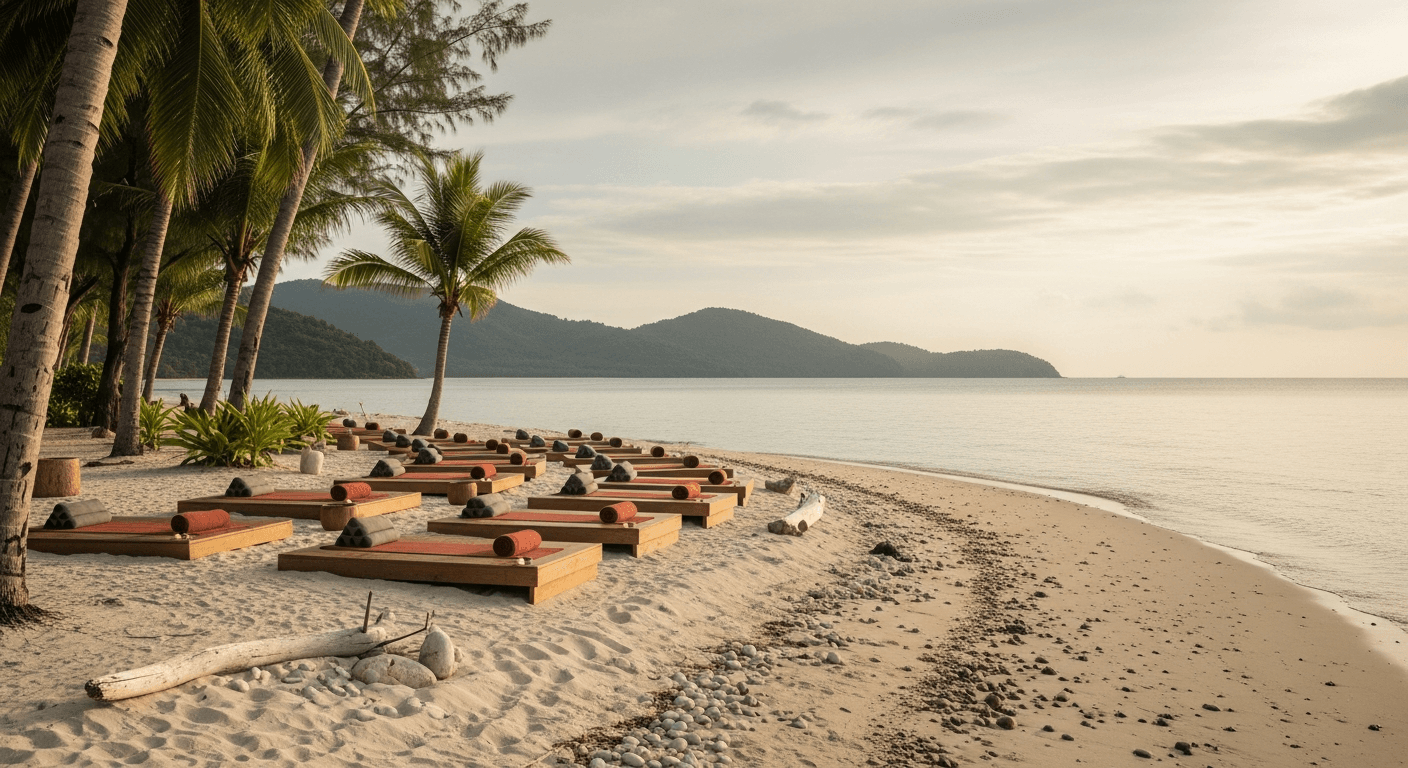
Independent programming requires advance coordination on equipment and space. Hotels provide yoga mats, but rarely stock 30 bolsters, 30 eye pillows, or 30 Mexican blankets for restorative sessions. Practitioners either bring their own or you source rentals. A sound healing session needs adequate floor space, low lighting capability, and minimal ambient noise. Beachfront lawns work at sunrise or sunset. Pool decks near bar areas do not.
Muay Thai sessions need gloves, pads, and a trainer-to-participant ratio that keeps the session safe. One trainer handles 12–15 participants maximum. Larger groups require two trainers working in rotation. Confirm whether the practitioner provides equipment or expects the client to arrange it.
Backup space matters. Outdoor sessions scheduled for 7:00 can hit weather delays. Have an indoor alternative confirmed in advance. The hotel's conference room may be set for an afternoon meeting but available until 10:00. A large guest villa can absorb 20 participants for a sound bath if the lawn floods.
In-house programming at Six Senses-tier properties
Six Senses Samui, Kamalaya, and similar properties operate dedicated wellness centers with full-time staff trained in group facilitation, multi-day detox protocols, and specialized modalities. These hotels scale wellness programming internally and include it in venue proposals as a core capability, not an add-on.
A four-day executive retreat at Six Senses can run entirely on in-house programming: morning yoga with the resort's instructor team, afternoon sound healing in the hilltop sala, private Reiki sessions, and guided meditation. The property absorbs coordination overhead and maintains quality control through employee training and supervision.
Mid-tier properties—four-star beachfront resorts, private villas, boutique hotels with 40–80 rooms—do not staff this depth. Their spa operates as a revenue center for individual guests, not a group programming engine. Layering independent practitioners onto these properties creates the programming flexibility a Six Senses delivers natively, but requires external coordination and vendor management.
The cost difference is not negligible. A villa-based program with independent wellness programming runs 30–40 percent below a comparable program at a Six Senses property when venue, accommodation, and programming are summed. The trade-off is coordination complexity and the need for a production partner who manages the independent vendor layer.
Halia maintains vetted practitioner relationships across Koh Samui and responds to program briefs within 48 hours. If your incentive or retreat brief includes wellness programming that exceeds hotel spa capacity, start a conversation.