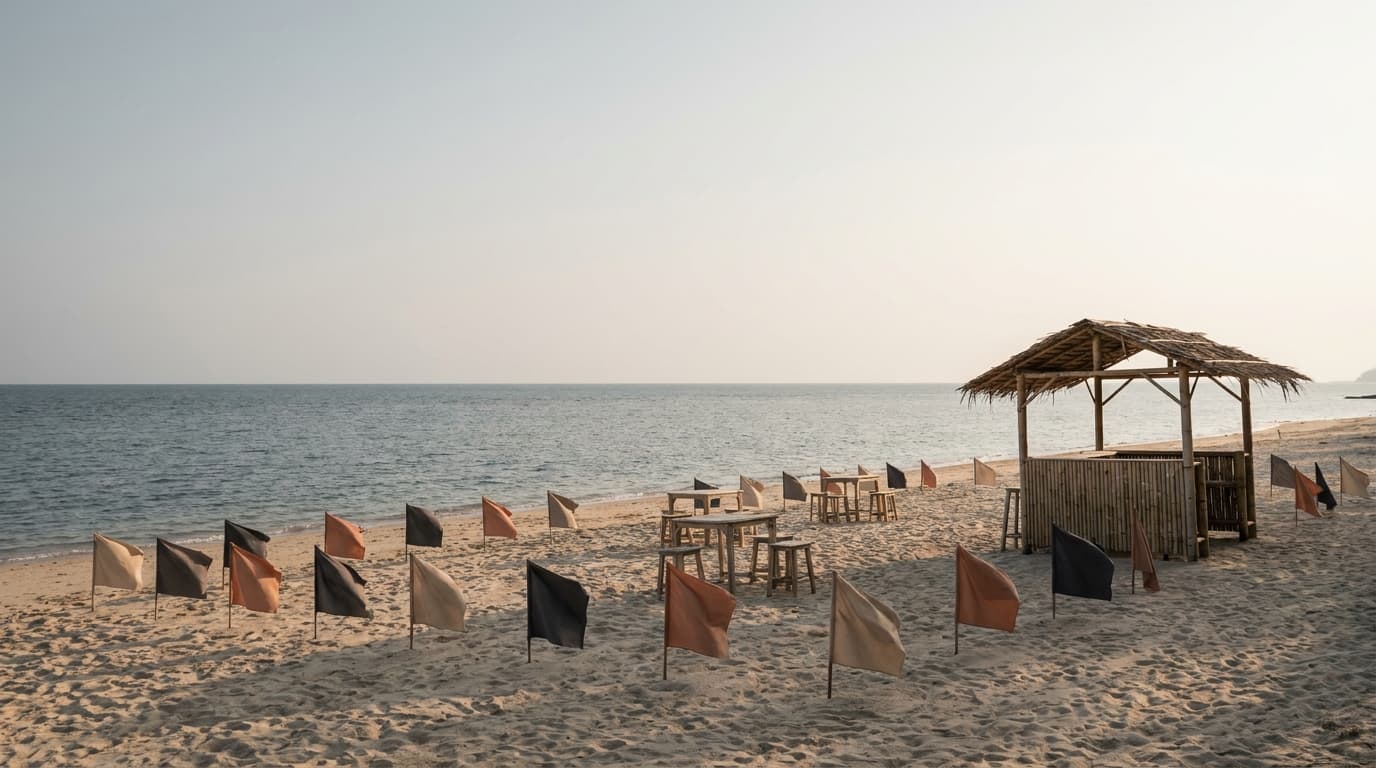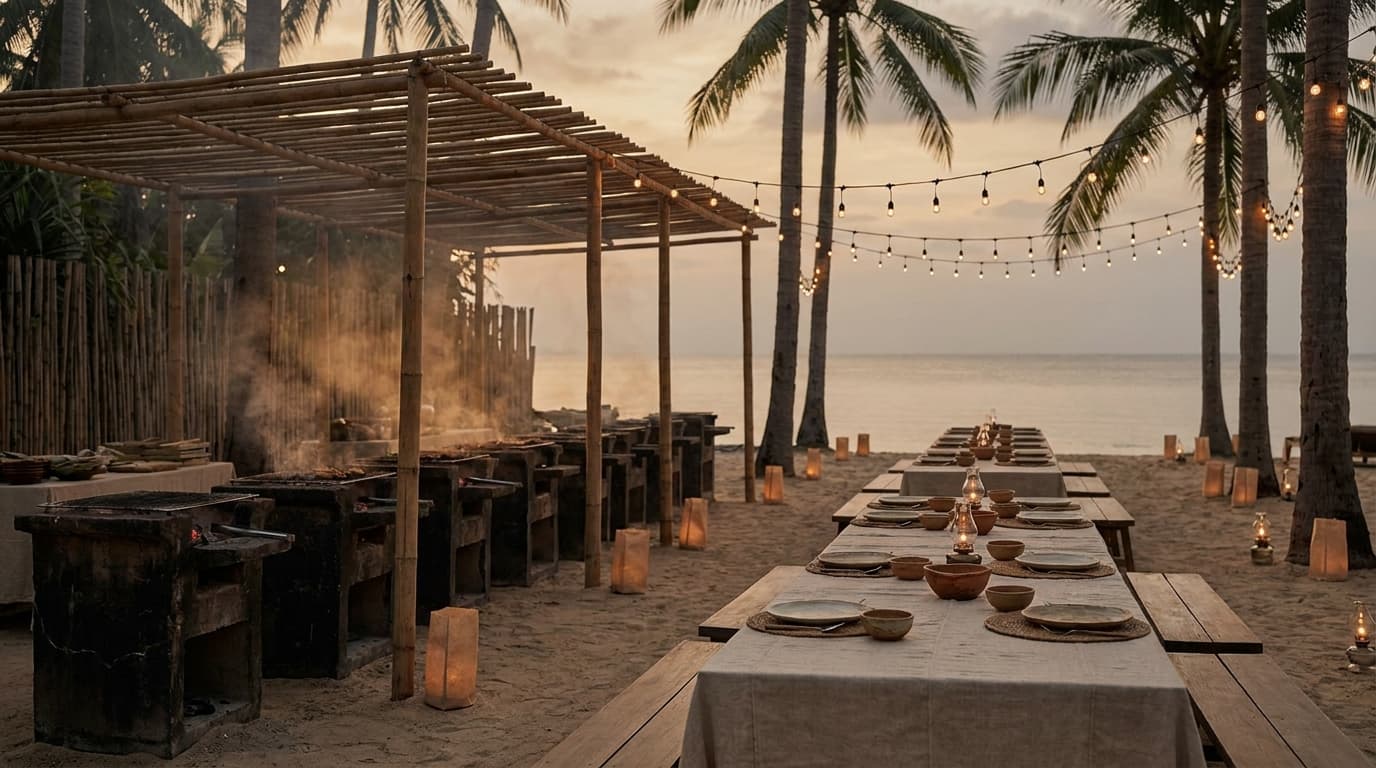
A corporate beach BBQ at a resort is a hotel-catered event with a production layer on top. The hotel controls the food and beverage on its sand, and a production partner builds the evening around it: grills, seating, lighting, sound, entertainment and crew. Planners who treat it as a single vendor job usually find a gap between what the kitchen can cook and what the beach needs.
This guide covers who is allowed to do what, how to split the work, and the four issues that cause the most last-minute changes: halal service, sound curfews, weather cover and beverage structure.
Who can cook on the hotel's beach
The hotel's kitchen is the default caterer for any food served on the hotel's beach. This is standard practice for resorts, and Samui is no exception. Outside caterers are often refused outright. Where they are accepted, expect a venue fee, a corkage-style charge, or a requirement to use the hotel's service staff.
The reasons are practical. The hotel holds the food safety obligations, the insurance and the liability for guests. It also has to protect its own food and beverage revenue. Arguing the point rarely works. Plan around it.
Ask the hotel three questions before you sign anything:
- Is outside catering permitted on the beach, and at what fee?
- Has the kitchen staged a beach BBQ for a group of your size before?
- Which parts of the setup will the hotel supply, and which parts can an outside partner bring?
The third answer matters most. Many hotels can cook very well and have never built a beach BBQ. Their banquet teams are set up for ballrooms and plated dinners. A beach needs power runs, windproof lighting, leveled flooring on sand, grill stations that hold up against sea breeze and a crew that can set up and clear in tight windows. That gap is where a production partner fits.
What a production partner adds
A production partner supplies the physical event and the show. The hotel kitchen supplies the food and the licensed service. The two teams need a single run sheet and one point of contact on the day.
Production typically covers:
- Grill stations, including frames, wind shields and prep tables
- Dining seating and lounge seating, with low tables, cushions and cocktail furniture
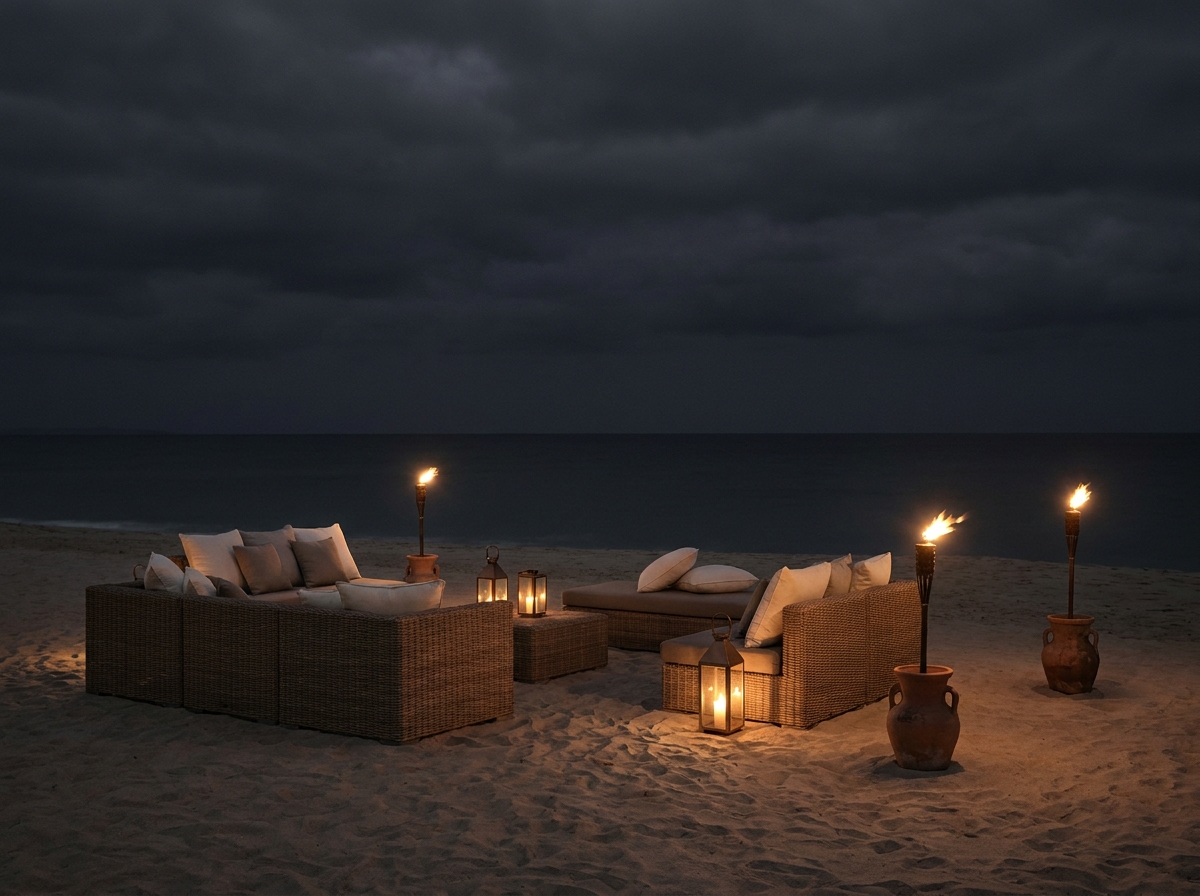
- Shoreline lighting, such as lanterns, uplighting on palms and path lighting
- Sound, including a PA sized for the beach and a monitor for the performers
- Entertainment, such as a live act, a fire performance or a DJ
- Staffing for setup, hosting and teardown
- Cleanup of the beach to the hotel's standard
The kitchen typically covers menu development, sourcing, cooking, food safety and the bar. Here is how the split usually works:
| Area | Hotel kitchen | Production partner |
|---|---|---|
| Menu and cooking | Designs and cooks all food | Advises on grill layout and service flow |
| Food sourcing and safety | Sources, stores and handles | None |
| Grill stations and equipment | Provides cooking staff and ingredients | Builds and positions stations, fuel, wind protection |
| Dining and lounge seating | Often limited to standard banquet stock | Designs and supplies layout and furniture |
| Lighting and power | Approves power points | Designs and installs shoreline lighting |
| Sound and entertainment | Sets curfew and volume limits | Supplies PA, performers and operator |
| Bar and beverages | Runs service under its license | Designs bar placement and signage |
| Event staffing | Kitchen and service team | Setup, hosting, runners, teardown crew |
| Backup space | Confirms availability | Prepares a rapid conversion plan |
Put this table into the contract as a responsibility schedule. Disputes on the day often sit in the gaps between two columns.
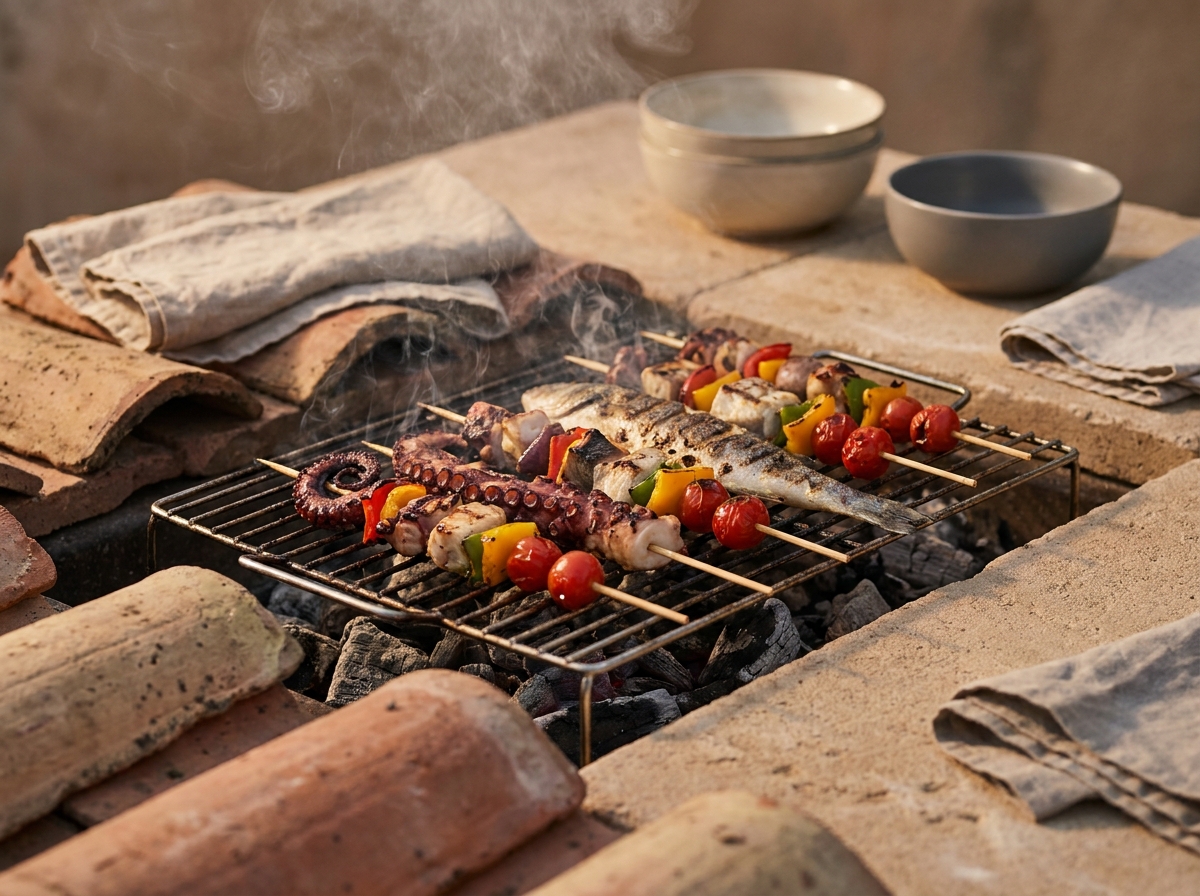
Halal service on a beach BBQ
A halal BBQ needs separately sourced meat and a dedicated grill and prep area. Cooking halal and non-halal food on the same surface does not meet the requirement, even if the grill is cleaned between batches.
For a group that includes Muslim guests, plan the following:
- Sourcing. The meat comes from a halal-certified supplier, and the hotel should be able to show the supplier's documentation. Do not accept a verbal assurance.
- Dedicated station. One grill is set aside for halal only, with its own utensils, tongs, boards and trays. A separate prep table sits next to it.
- Marinades and sauces. These must be free of pork products and alcohol. Check labels on bought-in sauces.
- Staffing. Assign a named cook to the halal station. Mixing crews between stations defeats the purpose.
- Labeling. Signage at the station and at the buffet, in English, so guests do not need to ask.
For a group of 120 guests with 30 requiring halal, a sensible layout is three main grill stations plus one halal station. Size the halal station for 30 guests plus a margin. A good halal station cooks for its guests first and stays separate from the main line.
Not every hotel kitchen holds a halal setup, and some will need to bring in a certified supplier. Raise this at the first site inspection, because sourcing takes lead time.
Sound, weather and beverage structure
Sound curfews
Resorts have other guests, and the beach carries sound well. Most properties set amplified music limits that taper in the evening, often around 10 pm or 11 pm. Some restrict volume from the start of service if the beach faces guest rooms.
Get the curfew and the volume limit in writing. Then design the evening around them: the loudest element, such as a live band or a DJ set, goes in the middle of the program, and the evening winds down to acoustic or ambient sound before the cutoff. Place speakers facing the water and away from the room blocks. Brief your entertainers on the limit before they arrive.
The covered backup
Every beach event needs a covered backup space. On Samui, the Gulf side sees its heaviest rain from roughly October to December. Rain can arrive in any month. Wind and high tide are separate risks, and both can shut down a shoreline setup.
A workable backup is a ballroom, a covered terrace or a restaurant that can host the full group. Agree on three things in advance:
- A decision time, usually 4 to 6 hours before service
- Who makes the call: the planner, the hotel duty manager and the production lead together
- A conversion plan, so the stations, lighting and seating move in a set order
Book the backup space as a firm hold. Without a hold, another group may take it.
Capped packages versus consumption
Beverages are the largest variable in the budget. Hotels offer two structures:
| Capped package | Consumption | |
|---|---|---|
| How it is priced | Fixed price per guest for a set number of hours | Billed on what is poured |
| Budget certainty | High | Low, unless a spend ceiling is set |
| Best for | Groups with predictable drinking, strict budgets | Mixed groups with many non-drinkers |
| Risk | Paying for drinks that go unused | Overspend if the bar runs long |
| Control | Time limit and drink list | Spend ceiling and bar closing time |
A capped package of two to three hours suits most corporate evenings. For mixed groups, consumption with a hard spend ceiling often costs less. In either case, confirm what counts as premium spirits, whether non-alcoholic drinks are included, and who authorizes extensions.
For budgeting, a beach BBQ evening with production commonly lands at USD 80 to 180 per person before beverages, depending on group size, entertainment and menu. Treat that as a planning range and confirm it against a priced proposal.
Planning the sequence
Start with the hotel. Confirm the beach policy, the kitchen's experience and the sound limits. Then bring in production with those constraints already fixed. Order the lead items as follows: halal sourcing, backup space hold, sound limits, beverage structure, then entertainment and design.
Halia works with the partner hotels on Samui and with the production teams that build these evenings. If you are adding a beach BBQ to a resort program, send us the brief with headcount, dietary needs, hotel and target date. Contact us to start.