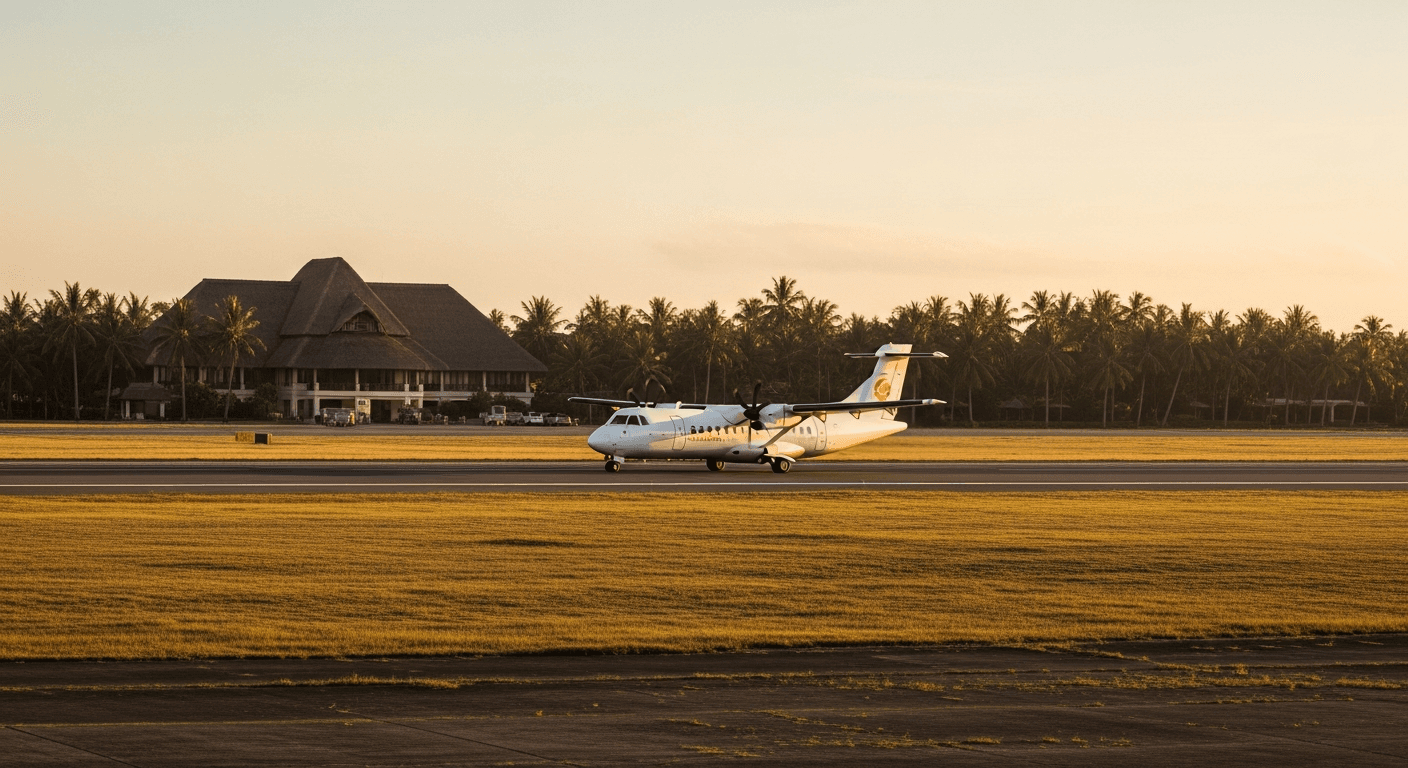
Koh Samui Airport (USM) operates under a unique ownership model. Bangkok Airways owns the airport and controls most of the flight schedule, which directly affects how you book airlift for groups of 15 or more. The airline allocates roughly 70% of daily slots to its own services, with the remainder distributed among Thai Airways, Thai Smile, and seasonal carriers. This concentrated inventory creates booking friction during November-March high season.
Group coordinators need to understand the route network, transit requirements, and the Surat Thani bypass option before locking in participant travel dates.
Direct route inventory to USM
Bangkok Airways operates the majority of direct connections. The carrier runs 12-16 daily flights from Bangkok Suvarnabhumi (BKK), depending on season. Flight time is 1 hour 20 minutes. Morning departures start at 06:00, evening flights run until 20:30.
Regional routes include:
- Phuket (HKT): 3-4 daily, 55 minutes
- Singapore (SIN): 2 daily, 2 hours 10 minutes
- Kuala Lumpur (KUL): 1 daily, 2 hours 5 minutes
- Phnom Penh (PNH): 4 weekly, 1 hour 35 minutes
- Chiang Mai (CNX): 1 daily, 2 hours 15 minutes
Thai Airways and Thai Smile each operate 2-3 BKK-USM frequencies, providing alternative inventory outside Bangkok Airways' block. These tend to open for booking 11 months out versus Bangkok Airways' 10-month window.
Bangkok transit windows for international arrivals
Most European and North American participants arrive through Bangkok. If you're booking same-day connections from BKK international arrivals to a USM domestic departure, minimum connection time is officially 90 minutes for Bangkok Airways. We recommend a 3-hour buffer for groups.
The constraint is baggage transfer reliability and group coordination. Bangkok Airways uses the domestic terminal at Suvarnabhumi, requiring a terminal transfer if your long-haul arrives at the international terminal (most flights). Bags sometimes miss tight connections. A missed bag on day one disrupts your opening session.
For groups above 20 people, schedule the USM leg for the afternoon or evening of arrival day. This accommodates long-haul delays and gives you a coordination window at BKK if participants arrive on different international flights.
Route and frequency comparison
| Route | Daily Frequencies | Flight Time | Primary Carrier | Group Block Notes |
|---|---|---|---|---|
| BKK-USM | 16-18 | 1h 20m | Bangkok Airways | 60+ seats available most days; book 90+ days out Nov-Mar |
| HKT-USM | 3-4 | 55m | Bangkok Airways | Useful for Phuket extensions; 30-40 seat capacity |
| SIN-USM | 2 | 2h 10m | Bangkok Airways | Opens 10 months prior; sells out fast for weekend arrivals |
| KUL-USM | 1 | 2h 5m | Bangkok Airways | Afternoon departure only; alternate days in low season |
| CNX-USM | 1 | 2h 15m | Bangkok Airways | Morning departure; 70-seat ATR configuration |
Surat Thani ground alternative for cost arbitrage
Surat Thani Airport (URT) sits 60km west of the Donsak ferry pier. It receives more frequent service from Bangkok (20+ daily flights across multiple carriers) and consistently lower fares. A group of 30 will typically save 35-45% on airlift using URT instead of USM.
The trade-off is time. After landing at URT, participants take a 1-hour minivan transfer to Donsak pier, a 1.5-hour ferry to Samui, then a 20-40 minute drive to most resort locations on the island. Total journey from URT wheels-down to hotel check-in: 3.5-4 hours, depending on ferry schedule coordination.
This route makes sense when your program budget is constrained and your agenda doesn't require same-day arrival productivity. If your opening session starts the morning after travel, URT works. If you need people operational by late afternoon on day one, pay for USM direct.
URT also provides overflow capacity. If Bangkok Airways blocks for USM are exhausted (common for groups booking inside 75 days), URT gives you guaranteed inventory through Thai Airways, Thai Lion Air, and AirAsia.
Slot contention and booking lead time
Bangkok Airways releases group space 10 months before departure. For travel between November 1 and March 31, submit requests by late January for the following season's travel. The airline allocates blocks on a first-request basis. Waiting until June to book December travel typically means accepting split flights or off-peak departure times.
We see denial rates above 40% for single-flight group blocks of 25+ passengers requested inside 90 days during high season. The airline protects inventory for individual bookings at higher yields.
If your confirmed participant count is below 15, book individual tickets rather than requesting a group block. You'll have better flight time options and avoid the group deposit structure. Bangkok Airways' group desk requires 30% deposit at booking and full payment 30 days before departure.
Buffer day strategy for bookend flights
Mechanical delays, weather (particularly June-October), and missed connections happen. For programs where day-one content is essential, build slack by flying participants in the day before your program starts. This turns a cancelled morning flight into a resolvable problem rather than a program failure.
The same logic applies to departures. If your program ends Friday afternoon and participants have Saturday evening international flights from Bangkok, book the USM-BKK leg for Saturday morning, not Friday night. A Friday evening flight delay pushes risk onto expensive long-haul tickets.
This costs one extra night of accommodation per participant. That's roughly $120-180 per person at midrange Samui hotels. Compare that to the rebooking cost and reputational damage of a blown international connection.
Most incentive groups that absorb this cost position the buffer night as free time rather than emergency margin. Tell participants they have Friday evening and Saturday morning to themselves before a 14:00 USM departure. The cost becomes a program feature.
Working with consolidated airlift
Some corporate clients consolidate all participants onto chartered equipment. Private charters into USM require 60+ days notice for aircraft positioning and slot allocation. The airport's single runway and Bangkok Airways priority scheduling mean charter slots typically get early morning (06:00-08:00) or late evening (after 20:00) windows.
Charter economics start making sense above 80 passengers on the BKK-USM route. A 120-seat A320 operates at approximately $24,000-28,000 per rotation, depending on positioning. That works out to $200-235 per person round-trip for an 80-pax load, comparable to published group fares but with total schedule control.
We coordinate charter logistics through broker partners when the math favors it, but most groups of 30-60 people get better value from Bangkok Airways published group rates.
Halia handles the full airlift coordination process, from initial slot requests through final ticketing and airport staff coordination on Samui. We respond to briefs with route recommendations and comparative costs inside 48 hours. Contact us with your travel dates and participant count.